

Workflow Automation for Business Leaders: Thinking Beyond Efficiency

For many organizations, workflow automation began as an operational improvement.
Paper forms were automated, email approvals were replaced with digital workflows, and repetitive manual tasks were eliminated; automation success was often measured in hours saved or paperwork reduced.
Those are still valuable outcomes, but they now only tell part of the story.
Today, workflow automation plays a much larger role in how organizations improve and manage their operations. Business leaders are increasingly using automation to understand how work moves across their organizations. With better visibility comes better collaboration, more informed decisions, and ultimately, a stronger foundation for continuous improvement.
It's also why the conversation around platforms like WEBCON has evolved. Rather than focusing solely on workflow automation, Business Process Management (BPM) has become a strategic business discipline. BPM helps executives understand and govern the way work gets done, making continuous improvement a cornerstone of the organization.
The question is no longer, "What processes can we automate?"
It's becoming, "How can automation help us build a better organization?"
The Biggest Benefits Aren't Always Operational
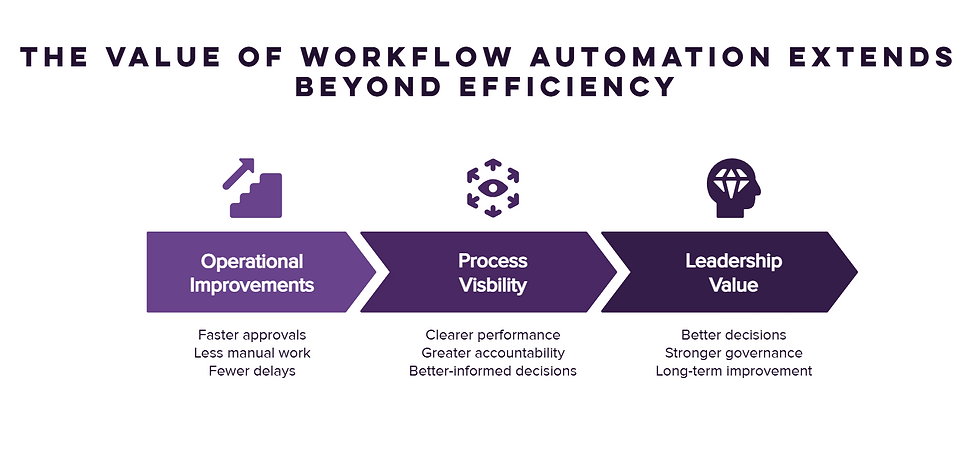
When organizations begin evaluating workflow automation, it's natural to focus on immediate operational improvements. Can approvals move faster? Can paperwork be reduced? Can repetitive tasks be eliminated?
Those are all worthwhile goals, and they're often the easiest ones to measure. That's why they're usually the first objectives organizations pursue when they begin automating business processes.
Business leaders, however, tend to evaluate success differently. Beyond efficiency, they're looking for greater visibility into business processes, more consistent ways of working across departments, and clearer accountability for the decisions that keep the organization moving forward. Those advantages make it easier to identify improvement opportunities before small operational issues become larger business challenges.
That's the point where workflow automation begins supporting something much bigger than operational efficiency. It becomes the foundation for Business Process Management, giving leaders the insight they need to continuously refine how work moves across the organization.
The organizations that realize the greatest value from workflow automation aren't necessarily the ones that automate the most work. They're the ones that gain the clearest understanding of how their business actually operates and use it to drive continuous improvement.
Visibility Leads to Better Decisions
The quality of leadership decisions depends on the quality of the information behind them.
When leaders have a clear view of how work moves through the organization, they're better equipped to prioritize improvement efforts, allocate resources effectively, and identify opportunities before small operational issues become larger business challenges. Visibility creates confidence because decisions are based on actual, measurable performance rather than assumptions.
Unfortunately, gaining that level of visibility isn't always easy. Many organizations still rely on fragmented information spread across emails, spreadsheets, disconnected applications, and in-person conversations that happen outside of any formal business process. As work becomes more difficult to see, it also becomes more difficult to understand, measure, and improve.
That's where workflow automation begins to evolve into Business Process Management. Rather than simply routing work from one person to another, BPM gives leaders the insight to understand how business processes actually perform.
Questions like:
Where is work consistently slowing down?
Which processes are creating the greatest bottlenecks?
Where will the next improvement have the biggest impact?
become much easier to answer because the information already exists within the process itself.
For executives, that's where workflow automation becomes much more than an operational tool. It becomes a way to make better decisions, respond more quickly to change, and continuously improve how the organization operates.

Consistency Creates Confidence
As organizations grow, it's only natural for different departments to develop their own ways of getting work done. Processes evolve over time, employees find shortcuts that work for them, and teams adapt to changing priorities. While that flexibility can be valuable, it also means the same request may be handled differently depending on who receives it, where it originates, or how familiar someone is with the process.
That inconsistency introduces more than just operational inefficiency: it makes outcomes less predictable. Employees aren't always sure what happens next, which means managers spend more time answering questions or resolving exceptions. As a result, leadership has a harder time knowing whether established processes are actually being followed.
This is where BPM makes a meaningful difference. Instead of relying on tribal knowledge or individual habits, organizations can establish a common process that guides work while still allowing for exceptions when genuinely needed.
New employees can become productive more quickly, and managers spend less time correcting avoidable mistakes. That consistency also gives executives confidence that important decisions are being supported by processes that operate the same way across the organization.
Long-Term Value Starts with Connected Processes
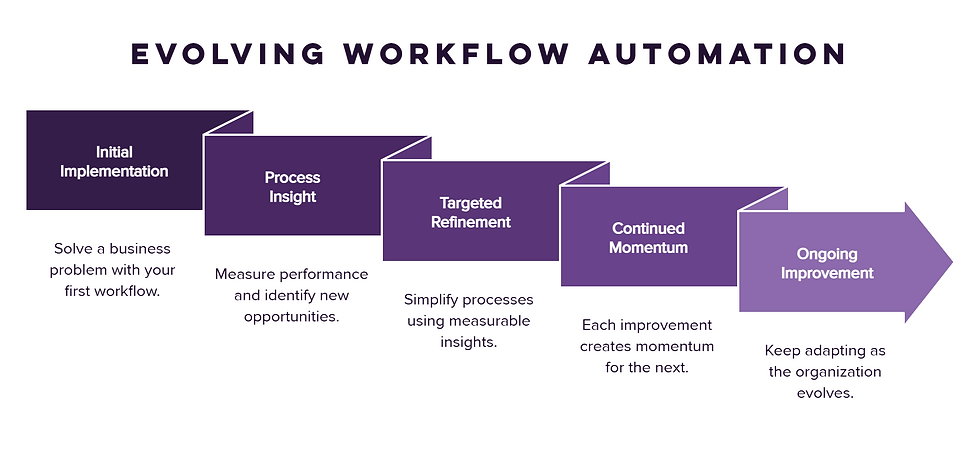
Most workflow automation journeys begin with a single project. It might be employee onboarding, a purchasing workflow, or a contract approval process—something that solves a specific business problem and delivers immediate value.
As organizations gain confidence in automation, they naturally begin looking for additional opportunities. More workflows are introduced, more departments get involved, and individual successes start to build on one another. That's an important milestone, but it's also where the conversation needs to evolve.
Long-term value doesn't come from simply having more automated workflows. It comes from understanding how those workflows connect to support broader business processes.
When organizations can measure performance across those processes, identify opportunities for improvement, and adapt as business needs change, workflow automation becomes much more than a series of successful projects. It becomes an engine for continuous improvement.
That's where Business Process Management delivers its greatest value. Rather than treating automation as a collection of isolated technology initiatives, BPM provides the structure for continuous improvement across the organization. Workflow automation stops being something the IT department implements and becomes something the business embraces as an ongoing strategy for operating more effectively.
Workflow Automation Should Continue Evolving
No business stands still. Organizations grow, markets change, regulations evolve, and customer expectations continue to shift. The business processes supporting those organizations have to evolve right alongside them.
That's why successful workflow automation is never really "finished." The first implementation isn't the destination—it's the beginning of a longer process of learning, refining, and improving how work moves through the organization.
As organizations identify new opportunities for improvement, they shouldn't have to delay meaningful changes because they're worried about the impact on day-to-day operations. That's one of the reasons we recommend WEBCON. Its InstantChange™ architecture is designed to reduce the risk traditionally associated with process improvements, allowing organizations to treat change as an opportunity for growth rather than a disruption to avoid.
That's the real value of Business Process Management. Continuous improvement isn't something that happens after workflow automation—it becomes part of how the organization operates. When process improvement becomes an ongoing discipline rather than a one-time initiative, workflow automation delivers value long after the first workflow goes live.
Leading Through Better Processes
Workflow automation has never really been about eliminating paperwork or speeding up approvals. Those are important benefits, but they were never the destination.
The organizations that realize the greatest value from workflow automation use it to build better business processes, make more informed decisions, and create a culture of continuous improvement. That's also the lens through which we evaluate Business Process Management platforms.
It's one of the reasons we continue recommending WEBCON to organizations looking beyond short-term efficiency gains. Designed for continuous evolution, WEBCON helps organizations improve visibility, strengthen governance, and refine business processes over time without treating change as a disruptive event or every workflow as a standalone project.
For business leaders, features and technology will always matter. The more important question is whether a platform can continue creating value long after the first workflow has been deployed. Can it support ongoing improvement as the organization grows, adapts, and changes?
That's where workflow automation becomes something much bigger than an operational initiative. It becomes a leadership strategy—one that helps organizations continually improve not just how work gets done, but how the business itself evolves.


Comments