

Process Bottlenecks: Why You Can't Improve What You Can't See

Most organizations don't have just one process bottleneck.
They have dozens of them.
Some are obvious, like a purchase request waiting for approval or an onboarding task that's been sitting untouched for days. Others are much harder to spot, hiding in disconnected systems, manual workarounds, and processes that have gradually evolved over time.
On their own, these processes may work well enough. As more workflows are introduced across different departments and systems, though, organizations often end up managing a collection of disconnected processes rather than a cohesive process strategy. Work slows down, visibility becomes fragmented, and bottlenecks become increasingly difficult to identify.
The challenge isn't a lack of automation. It's a lack of process management.
The Bottlenecks You Don't See Are Usually the Most Expensive
Organizations rarely struggle to identify work that's completely stopped. The real challenge is identifying the countless small delays that slow work down without bringing it to a halt.
Consider an employee onboarding process.
HR may think onboarding takes two days because their tasks are completed quickly. IT believes account provisioning is on schedule. Facilities prepares equipment on time.
Yet the new employee doesn't have everything they need until the end of the first week because no one is measuring the process from start to finish.
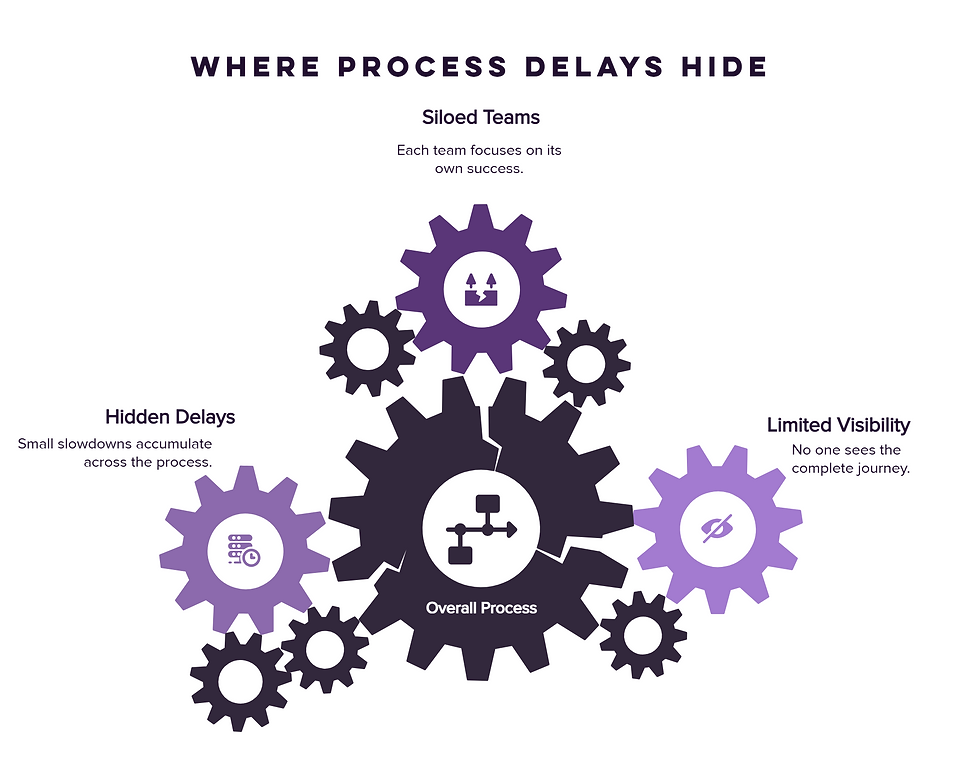
That's why many organizations underestimate the true cost of process inefficiencies. No single delay is significant enough to attract attention, but together they create longer cycle times, inconsistent experiences, and unnecessary manual work across the business. Because those delays are spread across multiple people and systems, no one sees their cumulative impact.
Without visibility into the complete process, organizations often improve the wrong things. They add staff instead of removing unnecessary approvals. They automate individual tasks without understanding where work actually slows down. They solve isolated problems while the larger process remains unchanged.
Improving a business process starts with understanding how work actually moves through the organization. Without that visibility, bottlenecks remain hidden—even in organizations that have already invested heavily in digital tools.
Why Good Organizations Still Develop Process Bottlenecks
Process bottlenecks rarely appear overnight. More often, they're the byproduct of an organization that's grown, adapted, and improved over time.
Think about how most business processes evolve.
A department identifies a problem and implements a better way of handling it. Maybe they replace a paper form with a digital one, automate an approval, or introduce a new application that streamlines a manual task. The change solves an immediate need, and the organization moves forward.
A few months later, another department improves a different process.
Then another.
And another.
Viewed individually, each of these changes is a success. Employees spend less time on repetitive tasks, approvals move faster, and manual work is reduced.
The challenge is that business processes rarely begin and end within a single department.
When each department focuses on optimizing its portion of the work, the overall process doesn't necessarily become more efficient. It simply becomes a series of individually optimized steps connected by handoffs, approvals, and multiple systems.
Over time, organizations often accumulate dozens—or even hundreds—of these workflows. Individually, each one solves a legitimate business problem. Collectively, they become increasingly difficult to govern, report on, and improve because no one has a complete view of how work moves across the organization.
Four Hidden Bottlenecks That Slow Organizations Down
Think about a traffic jam.
The delay isn't usually caused by every car driving slowly. It's typically the result of congestion at a single point in the roadway. As more vehicles arrive, that slowdown ripples backward, affecting traffic long before drivers ever reach the source of the problem.
Business processes work much the same way.
A delayed approval, a missing piece of information, or a breakdown between departments can create bottlenecks that affect every step that follows. The challenge is that, unlike traffic, those slowdowns aren't always visible.
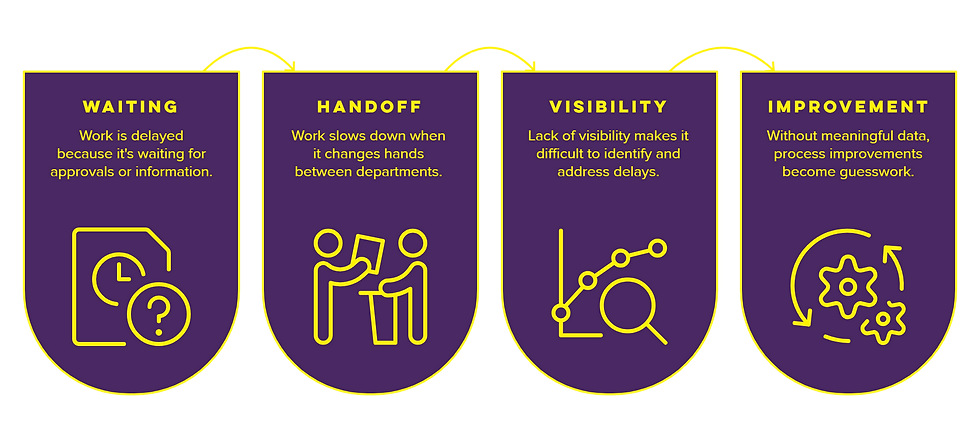
Waiting Bottlenecks
Work isn't always delayed because people are busy. Often, it's delayed because it's waiting.
An approval waits in someone's inbox. A request can't move forward because additional information is needed. A manager is out of the office, and no one else has the authority to approve the next step.
These delays are usually easy to recognize because everyone involved knows the work has stopped.
The greater challenge is understanding how often they occur, how long they last, and what impact they have on the rest of the process. Without that visibility, organizations tend to treat each delay as an isolated incident instead of recognizing a recurring pattern that needs to be addressed.
Takeaway: Waiting isn't always the problem. Unnecessary waiting is.
Handoff Bottlenecks
Every time work changes hands, there's an opportunity for it to slow down.
Employee onboarding may involve Human Resources, IT, Facilities, payroll, and the hiring manager. Vendor onboarding can require input from procurement, finance, legal, and compliance. Purchase requests often pass through multiple teams before they're complete.
Every handoff introduces another opportunity for work to slow down.
Sometimes the next team isn't notified. Sometimes required information is incomplete. Sometimes everyone assumes someone else owns the next step.
Nothing is technically broken, but the process stalls because responsibility becomes unclear between one step and the next.
Takeaway: Most process delays happen between departments—not within them.
Visibility Bottlenecks
One of the simplest questions in any organization is often the hardest to answer:
"Where does this request stand?"
If the answer requires searching through emails, Teams conversations, spreadsheets, or multiple business applications, the organization doesn't have visibility into the process.
That lack of visibility makes it difficult to identify recurring delays, measure performance, or recognize trends over time. Instead of proactively managing processes, organizations spend their time tracking down information and responding to problems after they've already occurred.
Takeaway: Visibility turns assumptions into measurable data.
Improvement Bottlenecks
Perhaps the most expensive bottleneck isn't found within the process at all.
It's the organization's ability to improve it.
Without reliable reporting, organizations often rely on assumptions rather than data. They know a process feels slow, but they can't identify where work is actually spending the most time. They hire additional staff when approvals need to be simplified, or automate another task without addressing the larger process surrounding it.
Continuous improvement depends on more than automation. It requires visibility into how work moves, where delays occur, and which changes actually improve performance.
Takeaway: Continuous improvement depends on evidence, not intuition.
Why Solving Individual Workflows Isn't the Same as Solving Process Management
By this point, it might seem like the solution is simply to automate more processes, but many organizations have already done just that. Expense reports are digital, purchase requests follow electronic approval paths, and employee onboarding has moved online. Those improvements matter—but they're only part of the picture.
Business processes rarely exist in isolation. A purchase request moves through budgeting, procurement, purchasing, receiving, invoicing, and accounting. Employee onboarding passes through HR, IT, payroll, facilities, and managers before it's complete.
Improving one step in that journey doesn't necessarily improve the journey itself.

If work still depends on manual handoffs, disconnected systems, or limited visibility between departments, delays simply shift from one part of the process to another. One team may become more efficient while the overall cycle time remains unchanged.
That's why organizations sometimes invest heavily in automation but see only incremental improvements. They've optimized individual activities without improving the way work moves across the organization.
Mature organizations eventually recognize that improving individual workflows isn't the end goal. The real objective is understanding how those workflows connect, measuring how work moves between them, and continuously improving the process as a whole.
This is where platforms like WEBCON provide value.
Rather than focusing on isolated workflows, they're designed to give organizations a consistent framework for designing, governing, and improving business processes across departments. The result isn't simply more automation—it's greater visibility into how work actually flows, where delays occur, and how processes can continue evolving as the organization grows.
Moving From Automation to Process Management
Every organization develops process bottlenecks over time. New tools are introduced, departments evolve, and individual processes are improved to solve immediate business needs. None of those changes are inherently problematic—in fact, they're often signs of an organization that's actively investing in improvement.
The challenge is ensuring those improvements continue working together as the business grows.
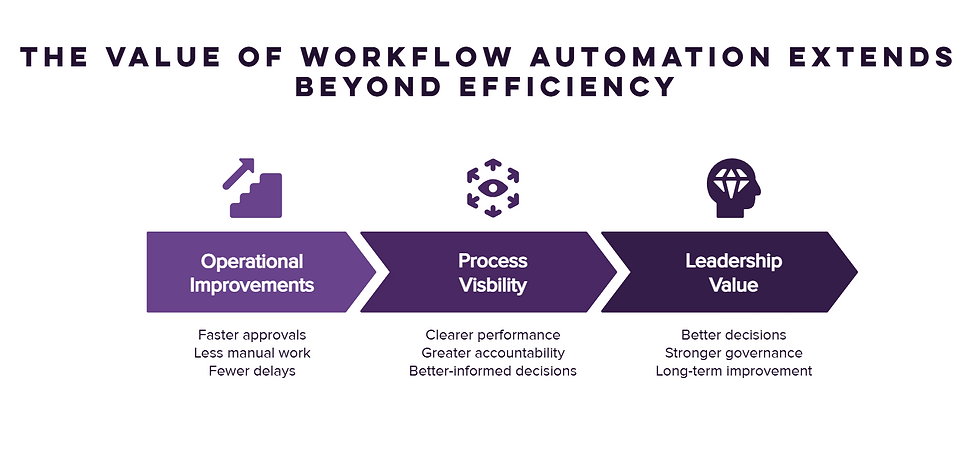
Organizations that consistently improve their operations don't simply automate more work. They build visibility into how work moves across departments, measure where delays occur, and create a framework for continuously refining their processes over time.
Platforms like WEBCON BPS support that approach by giving organizations a centralized way to design, govern, and improve business processes across the enterprise. Rather than creating another isolated workflow, they provide the visibility needed to identify bottlenecks, measure performance, and continuously improve how work gets done.
That's why Synergy begins every WEBCON engagement by understanding how work moves through the organization first—ensuring technology is applied to the right processes instead of simply automating existing inefficiencies.
Before deciding what to automate next, ask a simpler question:
Do you have a clear picture of how work moves through your organization today?
If not, it may be time to step back and evaluate the process before implementing the next workflow. With the right strategy, the right platform, and the right implementation partner, organizations can eliminate hidden bottlenecks while building a stronger foundation for continuous improvement.


Comments