

Why Intranet Governance Matters More Than You Think


An intranet doesn’t start out disorganized, nor is the intent for it to ever get there. It’s launched with a clear structure, defined goals, and a shared understanding of how the platform should be used. Content is curated, navigation is intentional, and the experience feels cohesive.
Then things begin to change.
New content is added. Pages are updated. Different teams contribute in their own ways. Each update may be justified, but without a consistent framework guiding those decisions, the structure starts to loosen, and content begins to build up.
A tool that was once organized and intentional becomes hard to follow and even harder to maintain.
This shift rarely happens all at once, of course. The build-up is gradual, but it’s there as the intranet slowly becomes more difficult to navigate, less reliable, and ultimately less useful to the people it was built for.
Understanding intranet governance means understanding how that drift happens, and how to prevent it.
How Intranets Become Difficult to Manage
The challenge isn’t usually how an intranet is built, but more how it evolves. As the platform grows, so does the volume of content, the number of contributors, and the complexity of the structure. Without clear oversight, small changes begin to compound.
Content accumulates. Navigation expands. Structure becomes less predictable.
At the same time, different versions of the same information begin to surface in multiple places. It becomes harder to determine what is current, what is outdated, and where employees should go for accurate information, making information unnecessarily difficult to access.
None of these issues are dramatic on their own, but together, they create an experience that feels inconsistent at best and difficult to trust at worst.
The Hidden Cost of “No Ownership”

A consistent pattern behind these challenges is unclear ownership.
Yes, content is often created by different teams, but responsibility for maintaining that content is less clearly defined. Over time, this leads to gaps that are easy to overlook but difficult to correct.
This often shows up as:
Content that remains published long after it’s accurate
Sections that are rarely reviewed or updated
Duplicate or conflicting information across teams
Uncertainty around who is responsible for making changes
When ownership isn’t clearly established, consistency becomes difficult to maintain. Even well-intentioned contributions can introduce fragmentation, making the intranet less dependable as a central source of information.
In many cases, by the time these issues become visible, employees have already adapted by working around the intranet rather than relying on it.
Why Governance Is Often Overlooked
While it might seem like a straightforward element of intranet development, governance actually tends to receive less attention than other areas when intranet discussions are concerned. It doesn’t have the same ‘visibility’ as a redesign or the introduction of new features, and its impact is often gradual rather than immediate.
As a result, it’s easy to deprioritize.
There’s also a practical challenge to it as well. Governance requires coordination across teams, and responsibility isn’t always clearly defined. Without a clear owner, it becomes something that is acknowledged but not fully implemented.
In many cases, governance isn’t intentionally ignored. It just isn’t addressed in a structured way until the effects become too difficult to ignore.
What Effective Governance Actually Looks Like
Effective governance doesn’t need to be complex, but it does need to be deliberate.
At its core, it creates a shared understanding of how content is managed across the intranet. That structure makes it easier to maintain consistency as the platform grows.
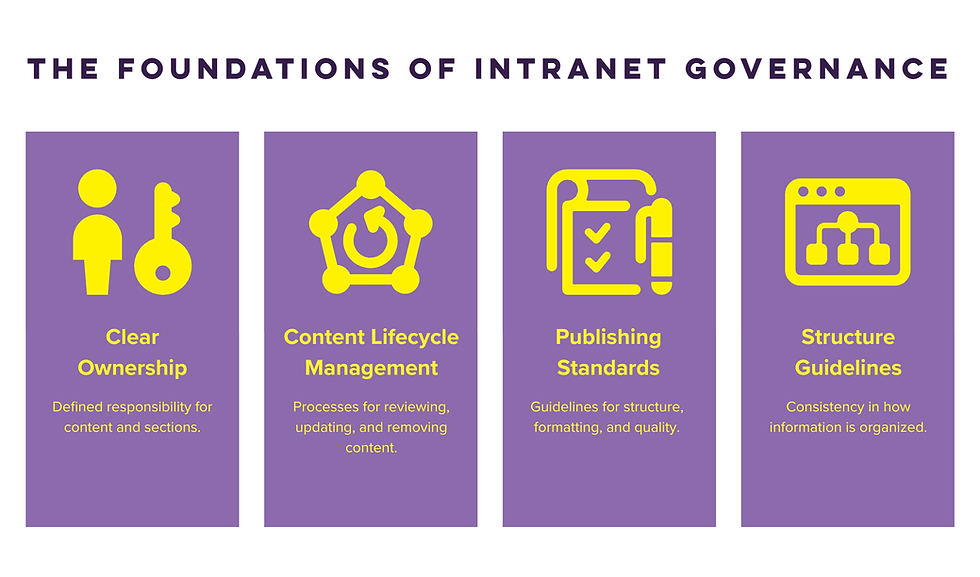
Strong governance typically includes:
Clear ownership — defined responsibilities for content and sections
Content lifecycle management — processes for reviewing, updating, and removing content
Publishing standards — guidelines for structure, formatting, and quality
Navigation and structure guidelines — consistency in how information is organized
Without this foundation, even well-designed intranets tend to become harder to manage when these elements aren’t accounted for.
Governance Without Over-Engineering It
Governance is sometimes associated with rigid processes or unnecessary complexity.
In practice, it works best when it’s straightforward and easy to apply.
The goal isn’t to restrict how teams contribute. It’s to provide enough clarity so that contributions remain consistent, even when multiple teams are involved.
That often comes down to a few practical considerations:
Defining ownership without adding unnecessary layers
Creating simple, repeatable processes for maintaining content
Establishing guidelines that support consistency without limiting flexibility
When governance is approached this way, it supports growth rather than slowing it down.
How Governance Supports Intranet Adoption
The connection between governance and adoption isn’t always obvious at first. As inconsistencies build, though, employees gradually lose confidence in the intranet and begin to look elsewhere for reliable information. Over time, the impact of that shift becomes clear.
When content across your intranet is consistently maintained and structured in a predictable way, employees are more likely to trust the intranet. They know where to go, what to expect, and how to find what they need.
Without that consistency, though, even the most well-designed intranets can become hard to navigate. Trust declines quickly when an intranet is deemed ‘difficult to use’, and employees begin to rely on other tools instead.
Content strategy and user experience both depend on a stable foundation. Governance provides that foundation by keeping the platform organized, reliable, and easier to use as the intranet evolves.
Governance Is an Ongoing Process
Governance isn’t something that can be put in place once and left unchanged. As an organization evolves, so does its intranet; new teams, new priorities, and new tools all introduce changes that need to be managed intentionally.

Maintaining consistent governance often involves:
Reviewing content and structure on a regular basis
Adjusting ownership as responsibilities shift
Using data to identify areas that need attention
Refining processes based on how the intranet is actually used
These adjustments don’t need to be large or disruptive. In many cases, incremental changes are enough to keep the intranet aligned with how the organization operates.
Build a More Sustainable Intranet
Most intranet challenges aren’t caused by a single issue. They develop gradually as small gaps in structure, ownership, and consistency begin to add up.
Addressing those challenges requires a broader view of how the intranet is managed, not just how it looks or what it contains.
At Synergy, we work with organizations to evaluate the full intranet experience, including how governance supports long-term usability and growth. By connecting content strategy, user experience, and ownership models, we help create environments that remain effective as they evolve.
If your intranet is becoming harder to manage or feels less reliable than it once was, a structured assessment can help identify where governance gaps exist and how to address them.


Comments