

The Four Layers of Successful AI Adoption

Part 2 of a Three-Part Executive Series
Missed the first article?
Technology is only one piece of successful AI adoption. Discover the four interconnected layers that help organizations turn AI initiatives into lasting business value.
In Part One of this series, we explored what OpenAI's Atlas announcement reveals about AI adoption. The biggest lesson wasn't about browsers or product strategy—it was about human behavior. People don't necessarily want another application to learn. They want the tools they already rely on to become more capable.
That raises an important question.
If successful AI adoption depends on people rather than technology alone, how should organizations evaluate whether they're actually ready?
Many AI conversations become surprisingly technical. Discussions quickly turn to model selection, licensing, security, integrations, infrastructure, and feature comparisons.
Those are all important considerations.
They're just not where successful AI initiatives begin.
Over the years, we've found that organizations often spend far more time evaluating technology than evaluating how that technology will actually be adopted by the people expected to use it. As a result, AI projects can become technology implementations rather than business transformation initiatives.
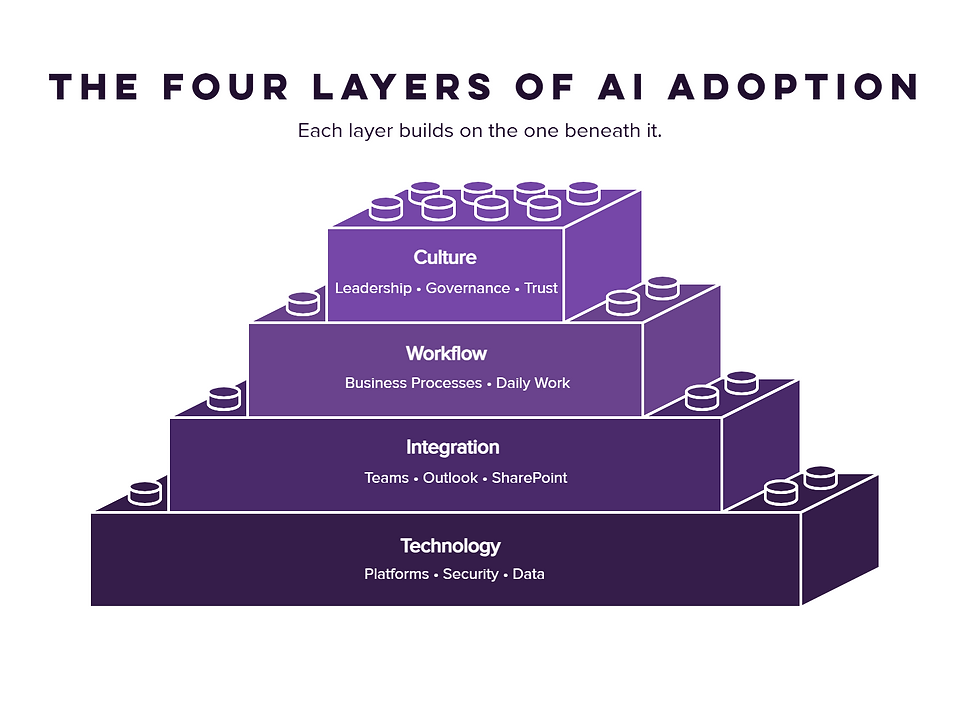
We've found it helpful to think about AI adoption as four interconnected layers. Each layer builds on the one before it, and weakness in any single layer can undermine everything that follows.
Rather than viewing AI as a software deployment, this framework encourages organizations to evaluate whether the people, processes, and culture surrounding the technology are equally prepared.
Layer One: Technology
Technology is where most AI conversations begin, and understandably so. Organizations want to know which platform they should choose, which models are most capable, what security controls are available, and how AI will integrate with their existing environment.
Those are all valid questions.
They're just rarely the questions that determine long-term success.
Today's leading AI platforms are advancing at an extraordinary pace. New capabilities appear almost weekly, and the differences between competing platforms continue to narrow as innovation accelerates across the industry. Choosing the right technology certainly matters, but it is becoming less of a competitive differentiator than many organizations assume.
What matters more is whether the technology supports clearly defined business objectives.
Before evaluating vendors, leadership teams should understand:
The business problems they are trying to solve.
The processes they hope to improve.
The users they are trying to support.
The data required to achieve meaningful results.
The success metrics that will determine whether the investment delivers value.
Without that foundation, organizations often purchase powerful technology without a clear understanding of how it will improve day-to-day operations.
Technology should enable the strategy: it should never become the strategy.
Layer Two: Integration
Once an organization has selected an AI platform, the next question becomes equally important:
Where will employees actually use it?
This is the lesson at the heart of OpenAI's Atlas announcement. Rather than encouraging users to adopt an entirely separate browser, OpenAI chose to fold Atlas' capabilities into an application millions of people already use every day.
The decision reinforces an important principle of technology adoption: the less people have to think about where a capability lives, the more likely they are to use it.
The same principle applies inside every organization.
If employees need to stop what they're doing, open another application, sign into another service, and manually move information between systems, AI quickly begins to feel like additional work instead of a productivity improvement.
Instead, organizations should look for opportunities to embed AI within the tools employees already rely on every day.
Examples include:
Drafting and summarizing emails directly within Outlook.
Assisting with meeting notes and follow-up actions inside Microsoft Teams.
Searching organizational knowledge stored in SharePoint without requiring employees to navigate multiple sites. (See our guide to AI-Enhanced SharePoint Online.)
Supporting customer service representatives directly within CRM systems.
Assisting project managers inside project management platforms.
Helping finance teams analyze reports without exporting information into separate AI tools.
The goal isn't simply to make AI available. The goal is to make AI almost invisible.
Layer Three: Workflow
This is where organizations begin realizing genuine business value. Employees rarely wake up in the morning excited about artificial intelligence. They wake up thinking about the work they need to accomplish.
Sales teams need to prepare proposals. HR departments need to update policies. Finance teams need to reconcile data. Customer service representatives need answers quickly. Project managers need status reports.
AI should improve those activities instead of becoming another activity in its own right.
That's an important distinction.
Far too many organizations still think about AI as a destination. In reality, AI works best as an enhancement to existing business processes, not a total replacement.
If you're evaluating where AI fits within your organization, our article AI Assistants for Business: What Actually Works provides a practical starting point.
Rather than asking employees to learn entirely new ways of working, successful organizations identify repetitive tasks, information bottlenecks, and manual processes where AI can quietly remove friction.
Some of the most valuable AI initiatives we've seen have been surprisingly modest:
Automatically generating meeting summaries and action items.
Drafting first versions of project documentation.
Helping employees locate policies and procedures more quickly.
Summarizing lengthy documents before review.
Accelerating proposal and statement of work creation.
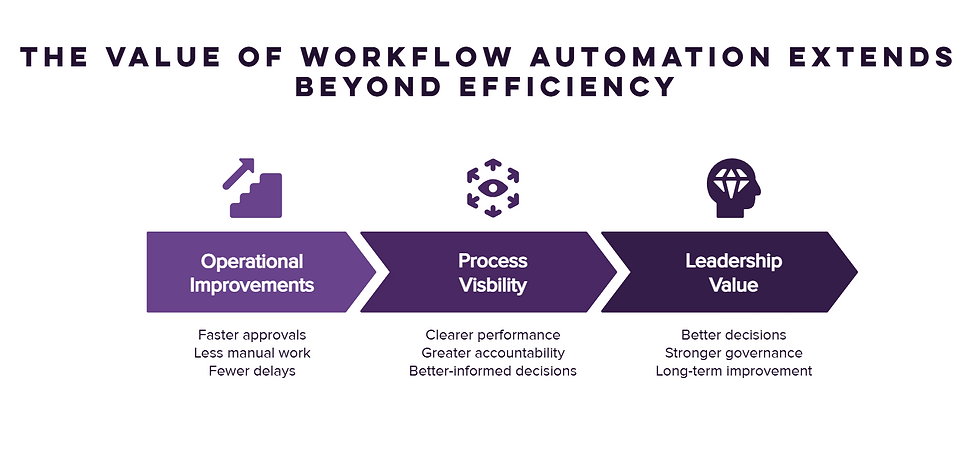
Individually, these improvements may seem incremental. Collectively, however, they can save thousands of hours across an organization while improving consistency and allowing employees to focus on higher-value work.
The workflow itself—not the AI—is where value is created.
Layer Four: Culture
Technology can be purchased.
Integrations can be built.
Workflows can be redesigned.
Culture, however, requires leadership. This is the layer many organizations underestimate.
Even the most capable AI platform will struggle if employees don't trust the results, understand when AI should be used, or feel confident that leadership has established clear expectations.
Successful AI adoption requires more than technical implementation: it requires organizational readiness.
That means:
Creating an environment where employees understand both the opportunities and the limitations of AI.
Establishing governance that protects organizational data without unnecessarily restricting innovation.
Helping managers understand how AI complements human expertise rather than replacing it.
Organizations that treat AI as solely an IT project often find adoption limited to isolated experiments. It’s the organizations that position AI as a strategic business initiative who are far more likely to see meaningful improvements across multiple departments.
Culture ultimately determines whether AI becomes part of everyday work or remains an interesting demonstration.
Moving Forward: From Framework to Strategy

Technology may be the first decision organizations make, but it shouldn't be the first priority.
Successful AI adoption depends on far more than choosing the right platform. It requires thoughtful integration, meaningful workflow improvements, and a culture that helps people embrace new ways of working.
The four layers are designed to work together. Technology enables integration. Integration supports better workflows. Workflows succeed when the organizational culture is ready to sustain them.
Understanding this framework is an important first step.
Putting it into practice is where the real work begins.
In the final article in this series, we'll translate these four layers into five practical questions every leadership team should answer before launching an AI initiative.


Comments