

Getting Started with WEBCON: A Practical Guide


Interest in process automation is growing quickly, but for many organizations, the challenge isn’t understanding its value—it’s knowing where to begin.
WEBCON provides a structured way to manage workflows, improve visibility, and bring consistency to business processes. But like any automation initiative, success depends less on the platform itself and more on how it’s introduced and applied within your organization.
Getting started doesn’t require a full-scale transformation. In most cases, the most effective approach is to begin with a clear understanding of your processes, identify a small number of high-impact opportunities, and build from there.
This guide outlines a practical path for organizations looking to get started with WEBCON, focusing on where to begin, what to prioritize, and how to set a strong foundation for long-term success.
Start with Your Business Processes
One of the most common mistakes organizations make when adopting automation is starting with the technology instead of the process.
WEBCON is designed to bring structure and consistency to workflows, but its effectiveness depends on how well those workflows are defined from the outset. Automating a poorly structured process doesn’t solve the underlying problem. In fact, it often just makes
inefficiencies move faster.
A more effective approach is to begin by looking at how work currently gets done across your organization. Where are delays happening? Which tasks require repeated manual effort? Where do handoffs between teams create bottlenecks or confusion?
These questions help uncover the processes that are best suited for automation.
Rather than attempting to redesign everything at once, the goal is to identify areas where structure, visibility, and consistency can be improved. This creates a stronger foundation for automation and ensures that workflows built in WEBCON reflect processes that already make sense.
Organizations that take the time to understand their workflows upfront tend to see better results, not just in how quickly automation is introduced, but in how effectively it scales over time.
Identify the Right First Workflows
Once you have a clearer understanding of your processes, the next step is deciding where to begin.
Not every workflow needs to be automated immediately. In fact, starting with the right type of process is often the difference between early success and stalled adoption.
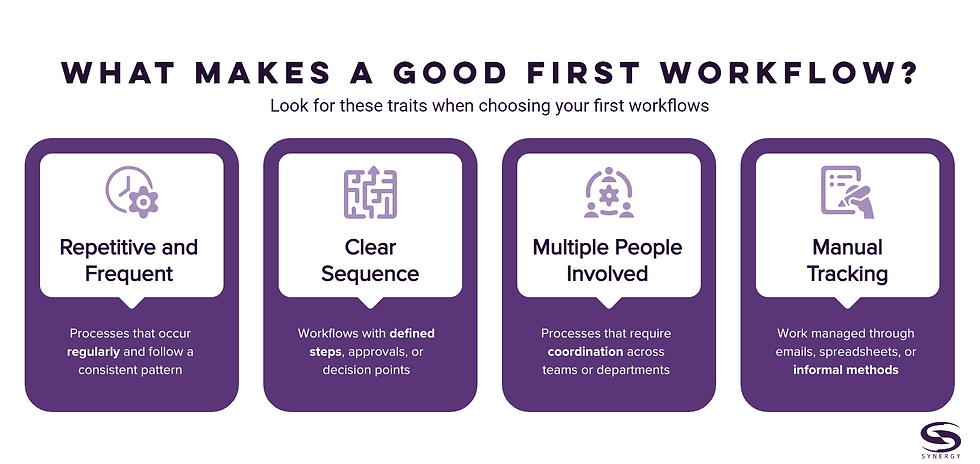
But what is the ‘right type of process’? Strong candidates for initial automation tend to share a few key characteristics:
They are repetitive and occur frequently
They follow a clear sequence of steps or approvals
They involve multiple people or departments
They rely on manual tracking, emails, or spreadsheets
Common starting points include processes like employee onboarding, purchase or expense approvals, and internal service requests. These workflows are typically well-understood, easy to define, and impactful enough to demonstrate value quickly.
In WEBCON, these types of processes can be structured into defined workflows where each step is clearly tracked, responsibilities are assigned, and progress is visible in real time. This eliminates the need for follow-up emails or manual status checks and creates a more predictable, manageable process.
Starting with a focused, high-impact workflow allows organizations to build confidence in the platform while delivering immediate, measurable improvements.
Define Scope and Set Priorities
A common challenge in early-stage automation is trying to do too much at once.
It can be tempting to identify multiple inefficiencies across the business and attempt to address them all in a single rollout. In practice, this often leads to delays, complexity, and difficulty measuring success.
A more effective approach is to define a clear scope for your initial effort. This typically means selecting one or two workflows, outlining how they should function, and setting expectations for what success looks like.
This stage is less about technical configuration and more about clarity. What should the process accomplish? Who is involved at each step? What decisions need to be made, and how should they be tracked?
WEBCON’s flexibility makes it possible to design workflows that reflect how your organization actually operates, but that flexibility is most valuable when it’s applied with focus. By narrowing the scope early on, you create a controlled environment for testing, learning, and refining your approach.
Align Stakeholders Early
Automation is often viewed as a technical initiative, but in reality, it’s just as much an organizational one.
The success of a workflow ultimately depends on the people who use it, contribute to it, and rely on its outcomes. That’s why aligning stakeholders early in the process is critical.
This typically includes IT, department leaders, and the individuals who are directly involved in the workflow being automated. Each group brings a different perspective, whether it’s technical feasibility, process ownership, or day-to-day usability.
Bringing these stakeholders into the conversation early helps ensure that workflows are designed with real-world use in mind. It also reduces the likelihood of resistance or confusion once the process is introduced.
When workflows in WEBCON are built collaboratively, they are more likely to reflect how work actually gets done and more likely to be adopted successfully.
Plan for Integration and Scalability
Even when starting small, it’s important to think about how your automation efforts will evolve over time.
Most workflows don’t exist in isolation. They connect to other systems, rely on shared data, and often feed into broader business processes. Planning for these connections early helps avoid rework later on.
WEBCON supports integration with a wide range of systems, allowing workflows to interact with existing tools rather than operate separately from them. This makes it possible to centralize process management without disrupting the systems your organization already depends on.
Scalability is another key consideration. The workflows you build today should be able to grow alongside your business, whether that means expanding to additional departments, increasing complexity, or standardizing processes across teams.
By thinking beyond the initial use case, you position your automation efforts for long-term success rather than short-term improvement.
Understand What Early Success Looks Like

One of the most important aspects of getting started is setting realistic expectations.
Automation is not about transforming every process overnight. Instead, early success is typically measured through incremental improvements that make work more efficient and more manageable.
This might include:
Faster turnaround times for approvals
Reduced reliance on manual follow-ups
Greater visibility into process status
More consistent execution of workflows
In WEBCON, these improvements come from introducing structure into processes that were previously informal or difficult to track. As workflows become more defined, organizations gain better control over how work moves and how decisions are made.
Recognizing these early wins is important. It builds momentum, reinforces the value of automation, and creates a strong foundation for expanding into more complex workflows over time.
Transitioning into Implementation
Once processes are defined, priorities are set, and stakeholders are aligned, organizations are in a much stronger position to move into implementation.
At this stage, the focus shifts from planning to building, meaning translating workflows into structured, trackable processes within WEBCON. This includes configuring steps, defining rules, and ensuring that each part of the workflow functions as intended.
For a deeper look at what this phase involves, it’s helpful to understand what to expect during implementation and how workflows evolve from initial design to full deployment.
Building a Long-Term Automation Strategy
Getting started is only the first step. Over time, organizations that see the most value from WEBCON are those that take a structured approach to expanding their automation efforts.
This often involves identifying additional workflows, standardizing how processes are built, and continuously refining existing workflows based on feedback and performance.
As more processes are brought into a centralized system, organizations gain greater visibility, consistency, and control across departments. This makes it easier to manage growth, maintain compliance, and adapt to changing business needs.
Rather than approaching automation as a one-time project, it becomes an ongoing strategy for improving how work gets done.
Getting Started with WEBCON
Starting with WEBCON doesn’t require a complete overhaul of your operations. The most effective approach is often the simplest: understand your processes, focus on a small number of high-impact workflows, and build from there.
By taking a structured, thoughtful approach, organizations can move from scattered, manual processes to clearly defined workflows that are easier to manage, track, and improve over time.
If you’re evaluating where to begin, it helps to map your processes, identify priorities, and take a measured approach to implementation. With the right foundation in place, WEBCON becomes more than just a tool—it becomes a platform for building more efficient, scalable ways of working.


Comments