

Before Investing in AI: Five Questions to Ask

Part 3 of a Three-Part Executive Series
Missed the earlier articles?
Before investing in AI, the most important decisions aren't technical—they're strategic. Explore five questions every leadership team should answer before committing to an AI initiative.
In the first two articles in this series, we explored why successful AI adoption depends on far more than selecting the right platform. Technology matters, but it is only one component of a much broader organizational change effort.
The bigger challenge isn't simply deploying artificial intelligence—it's using that AI to improve the way people work.
Before approving budgets, purchasing licenses, or beginning implementation, leadership teams should pause and ask five simple, non-technical questions. The answers will often determine whether an AI initiative becomes another underutilized software expense or a genuine competitive advantage.

Question 1: What Business Problem Are We Actually Trying to Solve?
One of the easiest mistakes organizations make is beginning with the technology instead of the business challenge. Artificial intelligence is exciting, making it tempting to look for places to use it simply because it exists.
Unfortunately, that approach often results in impressive demonstrations that never translate into measurable business value.
Instead, begin with the problem. Where are employees losing time? Which processes create frustration? What repetitive work adds little value while consuming significant effort?
Organizations that start with business outcomes tend to focus on improvements such as:
Reducing proposal creation time.
Improving customer response times.
Accelerating employee onboarding.
Making organizational knowledge easier to find.
Notice that none of these objectives mention AI.
That's intentional.
Employees care about solving problems, not implementing technology. When the business problem is clearly understood, the technology becomes much easier to evaluate.
Question 2: Will Employees Naturally Encounter This Capability?
Think about your own workday and how many applications you already use: email, Microsoft Teams, your CRM, your ERP, a project management platform, and a web browser.
Now imagine asking every employee to add another application to that list.
Even if the new application is excellent, adoption becomes significantly more difficult because it requires people to consciously change their routines.
This is why seamless integration matters. Whenever possible, AI should appear where work is already happening rather than requiring employees to go looking for it.
Ask yourself:
Does this capability appear inside existing workflows?
Will employees encounter it naturally?
Does it eliminate steps or introduce new ones?
Does it simplify work or create another destination?
The easier AI is to access, the more likely it is to become part of everyday work.
Question 3: How Will We Measure Success?
Many technology projects are declared successful the day they're deployed.
Business leaders should resist that temptation. Deployment is an implementation milestone: success is a business outcome.
Before launching any AI initiative, organizations should define what success actually looks like. That may include measurable improvements such as time saved, reductions in manual effort, faster customer response times, or increased process consistency.
Equally important is understanding how adoption will be measured over time.
To get a head start, read our deep dive on Measuring AI Adoption: Moving Beyond the Pilot Phase into Production, which outlines the metrics leadership teams should monitor long after implementation is complete.
Question 4: Are We Improving a Process or Simply Automating It?
Artificial intelligence has an incredible ability to accelerate work. However, that doesn't necessarily mean the work should exist in its current form.
One of the lessons we've learned through decades of workflow automation is that technology should never become an excuse to preserve inefficient processes. Automating a poor process simply allows the organization to perform that poor process faster.
Instead, AI initiatives should begin with process improvement.
For a breakdown of when to rely on structured workflows versus dynamic decision support, see our comparison of AI vs. Automation: When to Use Each in Your Business.
Only after those core process questions have been answered should AI become part of the solution.
Organizations that improve processes before automating them almost always achieve better outcomes.
Question 5: Are We Preparing People as Thoroughly as We're Preparing the Technology?
This may be the most important question of all.
Organizations often invest months preparing infrastructure, security, integrations, and licensing before launching a new AI initiative—but far less attention is given to preparing the people expected to use it.
Successful adoption requires more than technical readiness: employees need confidence, managers need guidance, and leadership needs to establish clear expectations. Training should focus on real business scenarios rather than software features alone.
Perhaps most importantly, though? Employees need permission to experiment.
Artificial intelligence will continue evolving rapidly. Organizations that encourage responsible exploration while providing clear governance will almost always adapt more successfully than organizations attempting to control every possible use case from the outset.
Technology creates capability. People create value.
What Thirty Years of Digital Transformation Has Taught Us
Although artificial intelligence dominates today's technology conversations, the underlying challenges are surprisingly familiar. Over the past three decades, we've helped organizations navigate major shifts including SharePoint, cloud computing, workflow automation, collaboration platforms, and digital workplace modernization.
The technology may have changed dramatically, but the principles of successful adoption have not.
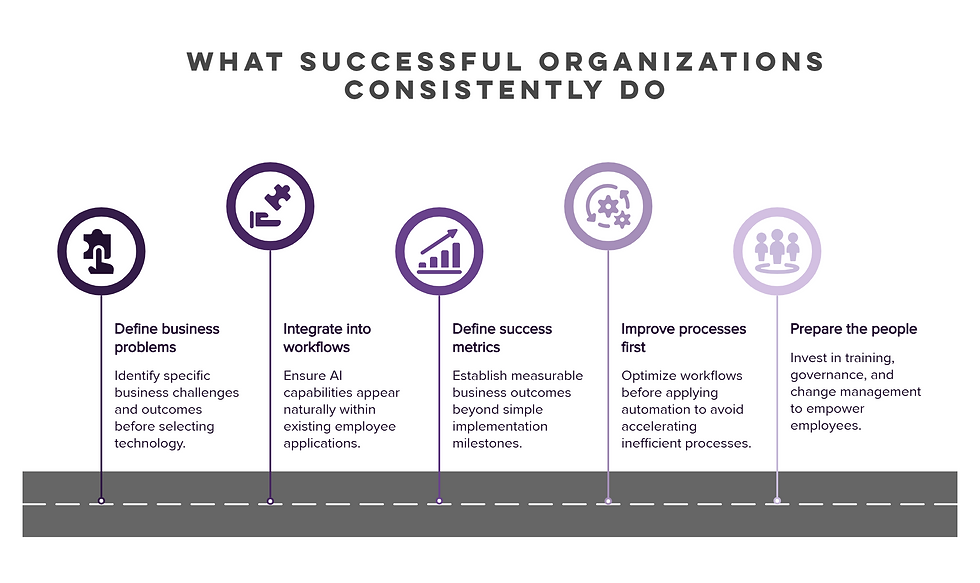
Across those projects, the organizations that consistently succeeded had five things in common:
They defined business outcomes before selecting technology.
They improved processes before automating them.
They integrated new capabilities into existing workflows.
They measured adoption—not just implementation.
They invested in governance, communication, and change management.
Those aren't AI best practices. They're digital transformation best practices. Artificial intelligence simply gives organizations another opportunity to apply them.
The Real Lesson from Atlas
Whether Atlas is remembered as a successful experiment, a product consolidation, or simply another step in OpenAI's rapid evolution is ultimately less important than the lesson it leaves behind. The announcement serves as a reminder that even one of the world's most innovative AI companies recognized something organizations have been discovering for years:
People don't necessarily want another destination.
They want the places they already work to become more intelligent.
The future of AI won't be defined by how many standalone applications organizations deploy. It will be defined by how seamlessly intelligence becomes embedded within the workflows employees already use every day. When AI quietly drafts an email, summarizes a meeting, finds the right document, or prepares the first version of a proposal, employees aren't thinking about artificial intelligence.
They're simply getting their jobs done more efficiently.
Ultimately, that's the future every organization should be pursuing.
The organizations that gain the greatest competitive advantage from AI won't necessarily be those that purchase the most licenses or experiment with the newest models first.
They'll be the organizations that thoughtfully remove friction from everyday work, empower employees to make better decisions, and integrate AI so naturally that it becomes part of the way business is done rather than another piece of software people are forced to use.
If OpenAI's Atlas announcement teaches us anything, it's that successful AI isn't about creating more technology.
It's about making work better.
And that's a lesson every organization can benefit from, regardless of where they are on their AI journey.


Comments