

Why Intranet Content Fails (and What to Do About It)

Most intranet content doesn’t fail loudly—it simply goes unused.
Pages sit untouched, updates go unnoticed, and over time, employees begin to rely on other tools to get the information they need. This gradual shift often creates a disconnect between what the intranet is intended to provide and how work actually gets done.
In many cases, the issue isn’t a lack of effort. It’s a lack of structure behind how content is created, managed, and maintained.
Publishing more content doesn’t necessarily solve the problem. Without a clear approach, it can make it more difficult for employees to find what they need, contributing to the kind of content overload that leads to disengagement and intranet fatigue.
Creating content employees will use requires a shift: from publishing for visibility to communicating with purpose.
Why Intranet Content Strategy Matters
Content plays a central role in whether an intranet becomes a trusted resource or something employees work around.
When content is relevant, easy to navigate, and aligned with employee needs, the intranet supports day-to-day work. When it isn’t, employees tend to look elsewhere for information, often relying on email, chat tools, or informal workarounds.
This can lead to a few familiar patterns:
Important information becomes harder to locate
Content is duplicated across multiple sources
Updates lose visibility as new content is added
Trust in the intranet as a reliable source begins to decline
These challenges don’t always surface immediately, but they can have a measurable impact on productivity, communication, and overall platform value.
What a Strong Intranet Content Strategy Looks Like

A strong intranet content strategy isn’t defined by how much content is produced, but by how effectively that content supports employees in their work.
This typically involves a more intentional approach to how content is planned and managed.
At a practical level, that means:
Clear purpose — content is created with a specific goal in mind
Audience awareness — different roles and teams receive relevant information
Defined ownership — responsibilities for content are clearly assigned
Consistency — structure and formatting make content easier to navigate
When these elements are in place, content becomes easier to maintain and more useful to the people it’s intended for.
Common Content Strategy Mistakes
Even when organizations recognize that their intranet content isn’t working as well as it should, the underlying challenges tend to follow similar patterns.
Some of the most common include:
Publishing without a clear goal
Content is created without a defined purpose or intended outcome
One-size-fits-all messaging
Content is often distributed broadly, even when it’s only relevant to certain groups
No content lifecycle management
Content is published but not regularly reviewed, updated, or removed
Lack of ownership
Responsibilities for maintaining content are unclear or distributed inconsistently
Limited connection to performance data
Content decisions are made without a clear understanding of how employees engage
Individually, these issues may seem manageable, but as these issues accumulate, they can make the intranet more difficult to navigate and less valuable as a resource.

Creating Content Employees Actually Use
Improving content strategy begins with a clearer understanding of how employees interact with information and what they need to do their jobs effectively.
This often involves focusing on a few key areas.
Understand Your Audience
Different roles require different types of information.
Content that is useful for one team may not be relevant to another. Taking the time to understand these differences makes it easier to create content that feels purposeful rather than generic.
Focus on Relevance
In many cases, the challenge isn’t a lack of content—it’s a lack of prioritization.
Reducing unnecessary or redundant content can often have a greater impact than adding new material. When content is clearly aligned with employee needs, it becomes easier to find and more likely to be used.
Structure Content for Usability
Even well-written content can go unused if it’s difficult to navigate.
Clear headings, logical organization, and consistent formatting all contribute to a better user experience. When employees can quickly scan and locate information, engagement tends to improve.
The Role of Personalization in Content Strategy
Not all content is meant for everyone.
Personalization helps ensure that employees are seeing content that is relevant to their role, team, or location, rather than relying on broad communication that may not apply to them.
This shift allows organizations to move away from a one-size-fits-all approach and toward more targeted, meaningful communication.
Modern intranet solutions support this by enabling:
Role-based content targeting
Dynamic content delivery
More tailored communication experiences
Platforms like Powell build on Microsoft 365 by bringing these capabilities together, helping organizations deliver content in a way that better reflects how employees actually work.
Maintaining and Improving Content Over Time
Content strategy is not a one-time initiative—it requires ongoing attention.
As organizations evolve, so do the needs of their employees. Without regular review, content can quickly become outdated or less relevant.
Maintaining quality on a consistent, regular basis typically involves:
Reviewing content for accuracy and relevance
Removing outdated or redundant information
Updating key resources as processes change
Using engagement data to guide improvements
This ongoing process helps ensure that the intranet continues to provide value rather than becoming more difficult to navigate.
Connecting Content Strategy to Intranet Adoption
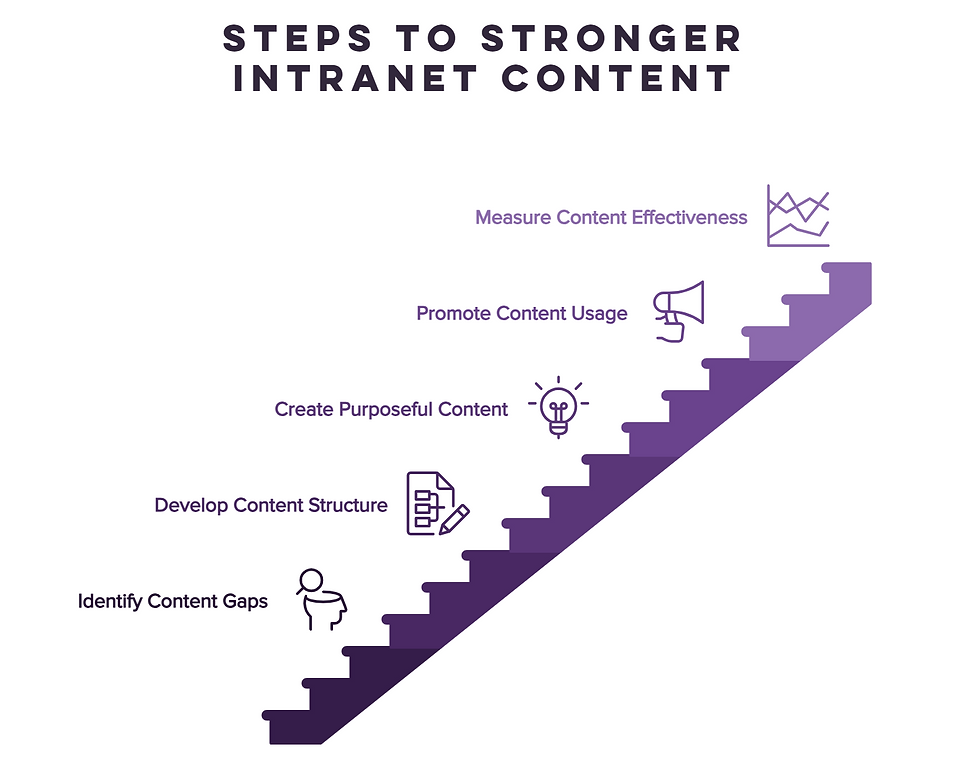
Content plays a direct role in how employees engage with the intranet.
When content is relevant, well-structured, and easy to access, employees are more likely to return to the platform and rely on it as part of their daily work.
When it isn’t, usage tends to decline, regardless of how capable the platform itself may be.
Improving content strategy is often one of the most effective ways to strengthen adoption and rebuild confidence in the intranet as a reliable source of information.
Build a More Effective Intranet Content Strategy
Creating content employees actually use requires more than good intentions—it requires a clear, structured approach.
In many organizations, content challenges are tied to broader gaps across ownership, governance, and user experience. Identifying where those gaps exist is the first step toward improving how the intranet performs overall.
At Synergy, we work with organizations to evaluate how their intranet content is created, managed, and delivered—connecting those insights to practical improvements that support both employee needs and business goals.
If your intranet content isn’t delivering the value it should, a structured assessment can help identify where to focus and outline a clear path forward.


Comments